

The Book
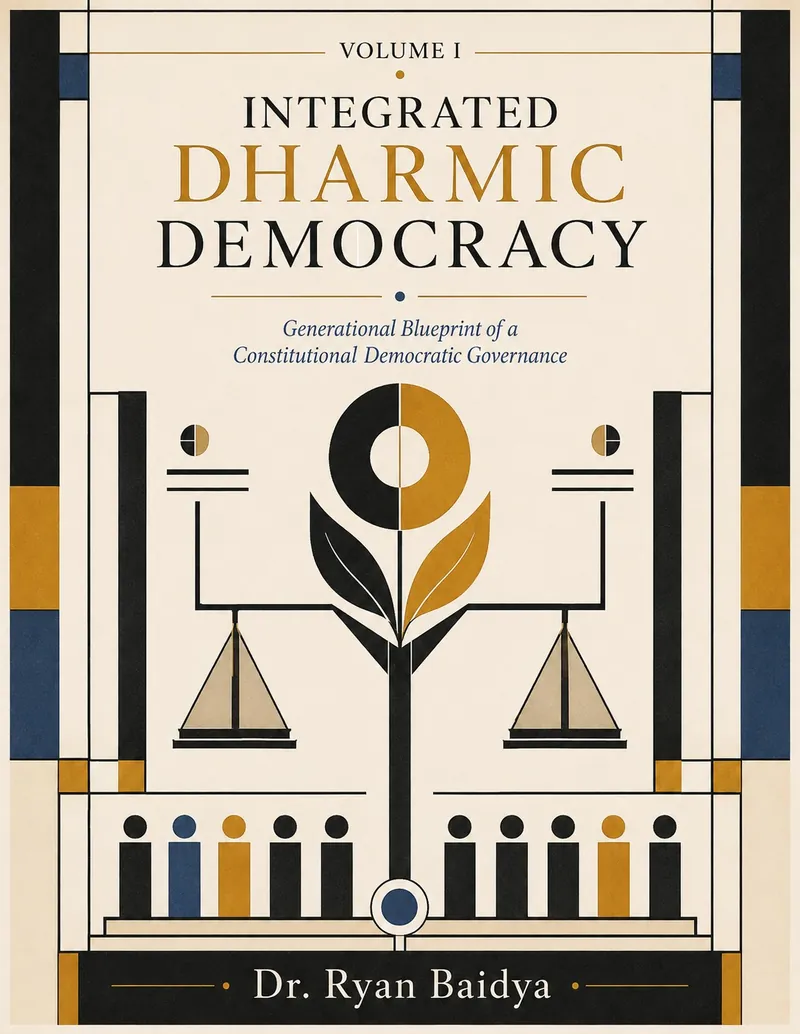
Integrated Dharmic Democracy: Generational Blueprint of a Constitutional Democratic Governance
Integrated Dharmic Democracy is a comprehensive study of constitutional democratic governance and the institutions required to sustain it across generations.
The book asks a foundational question:
Can democracy remain healthy if its constitutional structure is treated as permanent while society, technology, economics, culture, and public institutions continue to change?
The answer developed throughout the book is that democratic governance must contain within itself the capacity for renewal, accountability, institutional correction, and generational reassessment.
Integrated Dharmic Democracy—IDD—emerges from that inquiry.
It is presented not as a single reform proposal, but as a constitutional framework linking citizen sovereignty, elections, rights, responsibilities, judiciary, public integrity, policing, education, civilizational memory, property, institutional accountability, constitutional transition, and periodic renewal.
On this page
- The Question Behind the Book
- Why This Book Was Written
- From Reform to Constitutional Architecture
- A Book About Systems, Not Personalities
- The Architecture of the Book
- Part I
- Part II
- Part III
- Part IV
- Two Volumes, One Constitutional Argument
- How to Read the Book
- The Book and the Digital Supplements
- A Living Constitutional Project
- What This Book Does Not Ask
- The Generational Question
- Continue Exploring
The Question Behind the Book
Can democracy remain healthy if its constitutional structure is treated as permanent while society, technology, economics, culture, and public institutions continue to change?
The answer developed throughout the book is that democratic governance must contain within itself the capacity for renewal, accountability, institutional correction, and generational reassessment.
Why This Book Was Written
Modern democracies often debate individual problems separately.
Election reform is discussed apart from judicial reform.
Judicial reform is discussed apart from corruption.
Corruption is discussed apart from policing.
Education is treated separately from civic competence.
Rights are discussed separately from responsibilities.
Constitutional amendment is discussed without asking whether the constitutional architecture itself remains appropriate.
Yet these questions are connected.
A weakness in one institution can undermine another. A failure of accountability can spread across branches. An electoral system can produce legitimate governments while institutional structures remain vulnerable to capture. Courts may be independent yet insufficiently accountable. Citizens may possess rights but lack access to the information needed to exercise sovereignty effectively.
The book therefore approaches democracy as a system.
IDD asks how the parts of constitutional government should relate to one another so that democratic institutions remain accountable, adaptable, transparent, and ultimately subordinate to the citizen.
From Reform to Constitutional Architecture
The development of IDD grew from earlier constitutional studies of India, the United States, and Nepal.
Those studies began with different constitutional environments and different institutional problems.
But over time, recurring questions emerged.
How should constitutional systems correct themselves?
How can public institutions remain independent without becoming unaccountable?
How can citizens retain meaningful sovereignty between elections?
How can corruption be addressed structurally rather than episodically?
How should democratic societies preserve their history while protecting equal citizenship?
How can constitutions remain stable without becoming immovable?
These questions eventually moved beyond the circumstances of any one country.
Integrated Dharmic Democracy represents that next stage: an effort to develop a broader constitutional architecture from comparative experience.
A Book About Systems, Not Personalities
The central focus of the book is institutional design.
Political leaders change.
Political parties rise and decline.
Public attitudes shift.
Economic conditions change.
Technology transforms administration and communication.
A constitutional system, however, may remain in place for generations.
For that reason, IDD concentrates primarily on structures, incentives, checks, procedures, rights, responsibilities, and institutional relationships.
The purpose is not to design a system that depends upon unusually virtuous leaders.
It is to ask how democratic institutions might continue to function when ordinary human weaknesses—ambition, fear, self-interest, loyalty, corruption, faction, error, and institutional self-protection—inevitably appear.
A durable constitutional architecture should not assume perfect people.
It should anticipate imperfect ones.

The Architecture of the Book
The book is organized into 27 chapters across four major Parts.
Each Part develops a different layer of the IDD framework, moving from foundational democratic principles toward institutional design, constitutional implementation, and the larger generational vision.
The chapters are intended to be read sequentially, but individual sections can also serve as stand-alone references for readers interested in particular questions of constitutional design.
Part I
Foundations of Integrated Dharmic Democracy
Part I establishes the philosophical and constitutional foundations of IDD.
It examines the meaning of democracy beyond elections, the relationship between the citizen and the state, the role of Dharma in constitutional governance, and the distinction between governmental authority and citizen sovereignty.
This Part also develops the idea that democratic legitimacy depends not only upon institutional procedure but upon responsibility, integrity, restraint, and continuing public consent.
The central question is:
What should a democratic constitutional order ultimately be designed to protect and serve?
The answer begins with the citizen.
Part II
Institutional Architecture
Part II moves from principles to institutions.
It examines the structures through which democratic authority is exercised, restrained, reviewed, and corrected.
The discussion includes elections, legislatures, executive administration, judiciary, education, public integrity systems, oversight, policing, and mechanisms intended to reduce institutional capture.
This Part develops one of the book's central propositions:
No institution exercising significant public power should depend exclusively upon itself for accountability.
The goal is not to weaken institutions.
It is to make strong institutions compatible with strong accountability.
Part III
Rights, Integrity, and Constitutional Society
Part III examines the constitutional relationship between the individual, society, and the state.
It addresses fundamental rights, civic responsibilities, property, historical and civilizational memory, institutional transparency, public accountability, and the protection of citizens from both governmental excess and systemic failure.
This Part also develops the broader concept of the Integrity State—the proposition that modern constitutional democracy requires independent integrity functions alongside the traditional institutions of government.
The focus shifts from who possesses authority to how that authority must be exercised.
Part IV
Transition, Renewal, and the Future of IDD
Part IV turns toward implementation and generational continuity.
It examines how a society might transition from an existing constitutional structure to an IDD framework without creating institutional instability.
The book develops a structured transition process, accompanied by periodic review and correction, rather than assuming that a new constitutional order can responsibly emerge in a single moment.
This Part also examines constitutional renewal across generations and the possibility of cooperation among nations that independently adopt compatible IDD constitutional principles.
The book ultimately returns to its central theme:
No generation should receive constitutional authority while denying future generations the same opportunity to examine it.
Two Volumes, One Constitutional Argument
Because of its scope, Integrated Dharmic Democracy is organized into two volumes.
Volume I establishes the philosophical, constitutional, and institutional foundations of the IDD system and includes the opening chapters as well as the concluding generational framework.
Volume II develops the additional institutional, constitutional, and implementation architecture required to complete the system.
The chapter numbering continues across both volumes so that the work remains one continuous argument rather than two separate books.
The two-volume structure is intended primarily for readability and physical usability.
The intellectual structure remains unified.
How to Read the Book
There is no single required way to approach Integrated Dharmic Democracy.
Readers seeking the full argument may begin with Chapter 1 and proceed sequentially.
Readers interested primarily in constitutional design may move directly to the institutional chapters.
Students and researchers may use individual chapters as reference material.
Policymakers may focus on particular mechanisms—electoral design, judiciary, oversight, property, education, constitutional renewal, or transition.
Readers interested in the larger philosophy of IDD may concentrate first on the foundational and concluding sections.
The book is therefore both a continuous constitutional argument and a reference work.
The Book and the Digital Supplements
Not every component of the IDD framework is best maintained permanently inside a printed volume.
Some constitutional instruments require greater technical detail.
Some materials may evolve through further study.
Some are more useful in downloadable form.
For this reason, selected supporting material is maintained digitally through this website.
The digital supplements may include:
- the Model IDD Constitution;
- supporting constitutional instruments;
- transition and implementation documents;
- IDD membership and compliance frameworks;
- definitions and glossary material;
- diagrams and institutional maps;
- supplemental tables;
- reference material;
- corrections and clarifications;
- revised versions of supporting documents; and
- additional material developed after publication.
Each digital document should be identified by version and revision date so that readers can determine which edition they are using.
The printed book provides the argument.
The digital supplements provide the working constitutional materials.
A Living Constitutional Project
The publication of the book does not mark the end of the IDD inquiry.
Constitutional ideas improve through examination.
They should be questioned.
They should be compared with historical experience.
Institutional weaknesses should be identified.
Unintended consequences should be considered.
Alternative approaches should be examined.
And where stronger solutions emerge, the framework should be capable of incorporating them.
The website therefore serves as a continuing companion to the book.
It provides a place where supporting materials can evolve without silently altering the text readers already possess.
Revisions to digital materials can be dated, documented, and preserved.
This allows the intellectual framework to continue developing while maintaining a clear historical record of that development.
What This Book Does Not Ask
Integrated Dharmic Democracy does not ask readers to accept a finished constitutional doctrine.
It asks them to examine a constitutional proposition.
Can citizen sovereignty be made more continuous?
Can public integrity become an independent constitutional function?
Can institutional independence coexist with meaningful accountability?
Can democratic systems renew themselves without crisis?
Can a society preserve civilizational memory while guaranteeing equal citizenship?
Can constitutional design better protect future generations from institutional failure inherited from the present?
These questions are larger than any single country.
They belong to the continuing study of democracy itself.
The Generational Question
Every generation inherits institutions it did not create.
Some remain strong.
Some become outdated.
Some are weakened by practices their founders did not anticipate.
Some acquire powers never originally intended.
The responsibility of a democratic generation is therefore not merely to preserve inherited institutions.
It is to examine them.
To preserve what continues to work.
To repair what has weakened.
To replace what no longer serves its constitutional purpose.
And to preserve for the next generation the same freedom to decide again.
That is the question at the heart of Integrated Dharmic Democracy.
Continue Exploring
What Is IDD?
Read a concise introduction to the principles of Integrated Dharmic Democracy.
ExploreThe IDD Framework
Explore the major components of the constitutional architecture.
ExploreDigital Supplements
Access supporting constitutional documents, appendices, diagrams, and downloadable materials.
ExploreFrom India, America, and Nepal to IDD
Explore the earlier constitutional studies that led to the development of this framework.
ExploreUpdates and Corrections
Review revised digital documents, clarifications, and publication updates.
ExploreBook Contents
See how the four Parts are organized across the two volumes.
Explore